Starlight vs
Clay
Skip the spreadsheet. Describe the buyer — Starlight returns the list, the research, and the emails. Clay makes you build the system first.
Free plan, no credit card. Every message waits for your approval.

One prompt searches the web for your best-fit buyers
See the difference
Where Starlight pulls ahead of Clay, row by row.
| Feature | Starlight | Clay |
|---|---|---|
| Core model | Describe your buyer; the agents do the rest | Build the table, the waterfall, and the logic yourself |
| Setup effort | One sentence and a brief | Real learning curve; plays take hours to build |
| Enrichment | Built-in research and enrichment per lead | Waterfall you assemble yourself across 150+ providers |
| Outreach writing | Written per person, then scored before you see it | AI columns you prompt, then hand to a sequencer |
| Sending and follow-up | Email and LinkedIn follow-ups, sent in their working hours | Basic built-in sequencer, or export to a sending tool |
| Human review | Review mode or autopilot, per agent | Whatever your downstream sequencer does |
| Scheduling | Native booking pages and links included | Not offered |
| Entry pricing | Free plan, then pay for what you use, from $12/mo | Free tier, then $167/mo (Launch) |
| Seats | No per-seat fees | Unlimited seats on all plans |
Why Starlight wins
- The play ships. Search, score, research, write, follow up — already connected.
- Outreach is the product: scored drafts, LinkedIn, replies, booking.
- Free, then $12. You experiment instead of submitting a budget.
- Agents re-plan their own searches. Pipeline arrives without you opening a grid.
What you'd still do in Clay
- You are the operator: table, waterfall, logic, maintenance.
- It does not send a finished campaign. You still need a sequencer and a writer.
- $167 a month before a single email leaves.
What using it actually looks like
You describe the buyer. Starlight does the rest, and shows you its work.

Describe the buyer. That's the setup. One sentence about who you're trying to reach. Starlight works out the searches, runs them, and keeps digging once the obvious results run out.
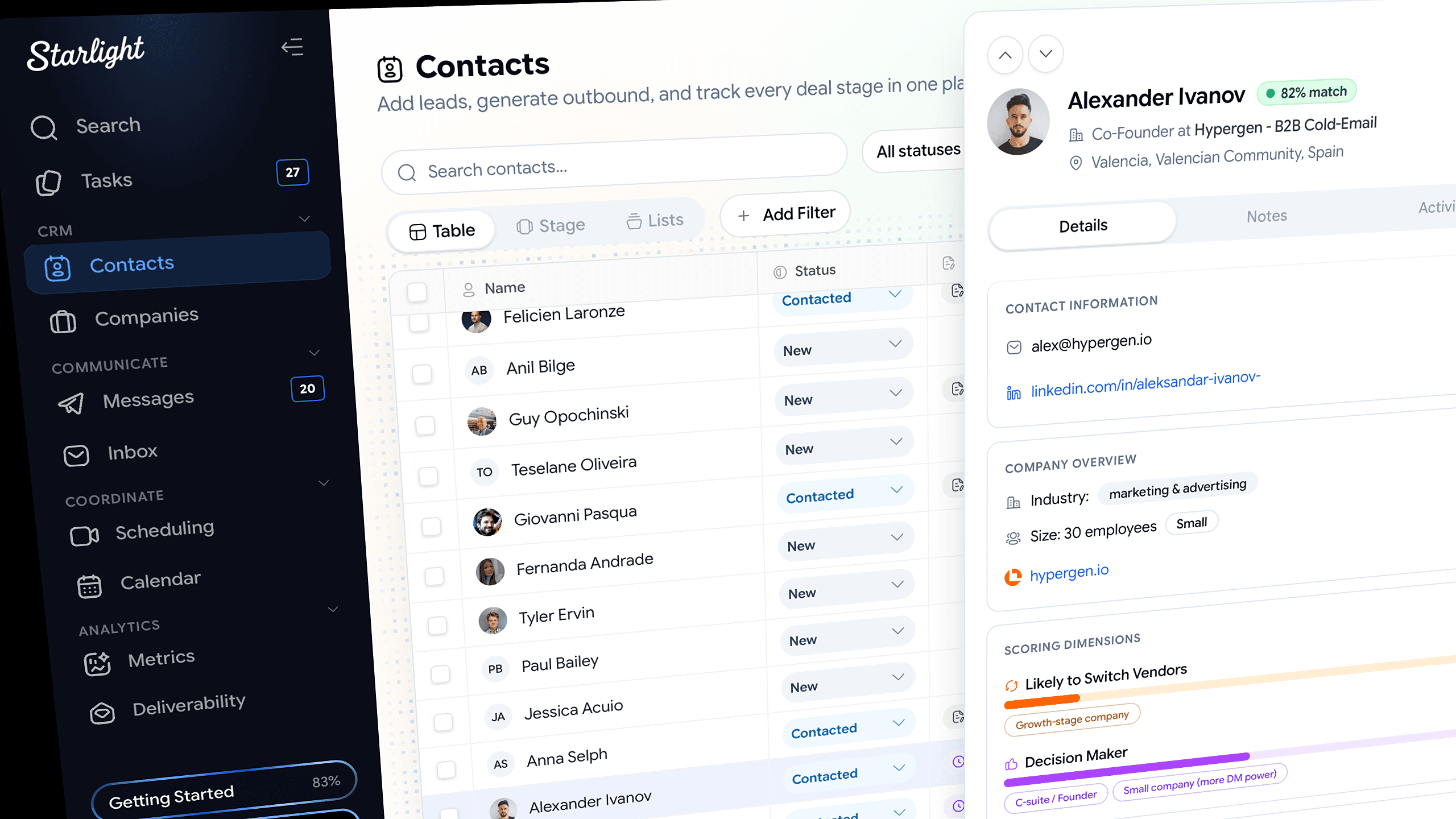
Bad-fit prospects never reach you. Everyone is scored against your ideal customer before you see them, with the reasoning shown. You spend your attention on the ones worth having.

You'll know if it's working. Your numbers come with a plain-English read on what changed and what to do next, instead of a dashboard you have to interpret yourself.
AI outreach you'd put your name on.
The worry with an AI sales agent is simple: what is it saying to people, and would you have said it? Starlight answers that by showing you. Every draft is graded before it reaches you, and the weak ones are rewritten automatically.
Grounded
Every claim traces back to something real about that person or their company. Invented details get caught.
Human
It has to read like you wrote it on a good day, not like a template with the gaps filled in.
On brief
It does what you actually asked for. Ask for a reply and it won't quietly push for a call instead.
What's left takes a few seconds each to approve, edit, or delete. Once an agent has earned it, you can let it send on its own.

Why you switch from Clay
Most teams do not have a Clay problem. They have a Tuesday problem: nobody built the play, so nobody got emailed. A workbench cannot fix a missing operator. It just invoices you $167 to stare at an empty table.
Starlight is the play, shipped. One sentence. One brief. An agent that returns researched people and scored copy across email and LinkedIn. That is the entire setup.
Stop assembling outbound. Start sending it. The finished version of the Clay play is free to try this afternoon.
Read more: How Starlight's agents work·Natural-language lead search·Starlight vs Apollo.io
Frequently
asked questions
See what it writes in ten minutes
Start free, describe your ideal customer, and read the sequence an agent comes back with. No credit card, no demo call, nothing to set up.
Other comparisons
View all comparisons →Cold email sending infrastructure
Starlight vs Instantly
Starlight researches each person and writes one message at a time. Instantly blasts volume.
CompareMultichannel outbound sequencer
Starlight vs lemlist
Starlight picks the people, researches them, and writes every line. lemlist is a canvas you fill.
CompareCold email infrastructure for agencies
Starlight vs Smartlead
Starlight finds the list and writes the copy. Smartlead only delivers what you bring.
Compare